Carriage-house doors belong on the old streets of Potwin and Westboro, and they suit plenty of newer houses too. OnPoint Pro Doors installs and repairs real wood and wood-look carriage doors across Topeka, sized to the opening and balanced for their weight, with a free estimate in writing before anything is ordered.
Tell us what the door is doing. The estimate is free; the work waits for your yes.
A real wood door is built from solid boards and frames, stained or painted, and on a historic house nothing else looks quite as right. It is also the heaviest door you can hang, and the one that asks the most of its owner over the years.
Wood-look doors give the same face from steel or composite. The skin is molded with a grain and finished in a stain-like color, the core can be insulated, and there is nothing to sand or refinish. From the sidewalk, most people cannot tell the difference.
Composite sits between the two: it takes a wood-grain texture, holds paint well, and does not rot, which matters on a detached garage where the bottom of the door spends winter against snow.
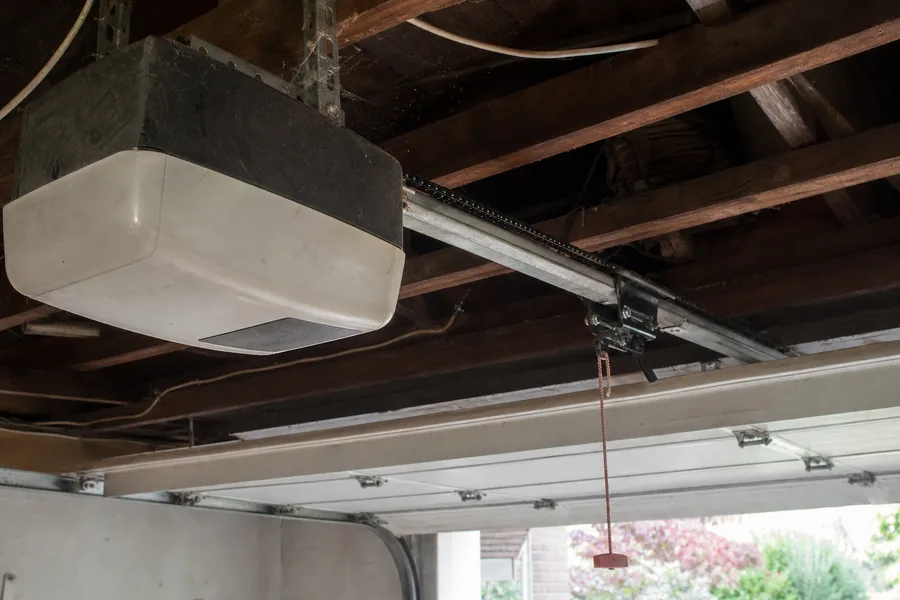
The original carriage houses had pairs of doors that swung outward on big strap hinges. Today's version keeps the look and rolls up overhead like any sectional door, so it works with an opener and needs no room in front of it to swing.
The look comes from the details: a center seam that suggests two leaves, vertical boards or crossbucks across the lower panels, a row of windows in the top section, and black or bronze handles and strap hinges fixed to the face. On a wide double opening, two single carriage doors side by side can look truer to an old carriage house than one wide door.
On the historic streets, matching the door to the age of the house is half the job; on a newer ranch, a simpler carriage pattern keeps the look from feeling dressed up.
Wind-driven grit scours a wood finish, summer sun dries and fades it, and winter brings snow that sits against the bottom rail for weeks. A wood door here needs its finish kept up every few years, sooner on a door that faces south or west or stands on an open lot.
Where the finish lets go, water gets in at the bottom edge and the end grain, and the lowest rail softens first. That is the honest trade-off with real wood, and it is laid out before anything is ordered.
If refinishing on a schedule does not suit the household, a wood-look door keeps the carriage look without any of it, and a lighter door also lifts by hand far more easily when the power is out.
Many old wood doors in town have been on their springs for decades, and those springs have often been swapped piecemeal for whatever was on hand. Mismatched springs lift one side harder than the other, the cable on the heavy side frays first, and the door starts to rise crooked.
A new carriage door is planned around its weight from the start. Springs are sized to the door's real weight, the cables and drums or pulleys to match, and wide wood doors get struts so their sections do not sag between the hinges. If the opener is not up to the new door, you hear that on the estimate.
Detached garages behind older houses often have openings that have settled out of square over the years, with jambs that have dried and split. A new door needs solid wood to fasten its track to, so the frame is checked at the first visit and any repair is listed on its own line.
Some of those garages have low headroom or no power at the door. Track and spring layouts for low ceilings exist, and a door that will run by hand is a reasonable choice where an opener is not wanted.
Color is worth settling on site as well. Dark stains look rich on an older house but fade and heat up fastest on a sunny wall, while painted carriage doors in the house trim color tend to wear more evenly and are simpler to freshen up later.
A carriage door is chosen against the house, then built around its weight.
An old wood door is often worth saving. Sagging sections can be brought back into line with struts and new hinges, a rotted bottom rail can be rebuilt when the rest of the wood is sound, and loose decorative hardware can be refastened.
Where rot has run through several sections, a repair stops making sense, and a carriage-look replacement is written up beside it so the two can be compared on paper. Either way, the springs on the old door are checked, since that is where most of the trouble on these doors starts.
No. They roll up overhead like any sectional door and work with a normal opener. The swing-out look comes from the trim, the center seam and the decorative hardware.
It can be, as long as the finish is kept up. Wind, sun and snow are hard on wood, so a wood door needs refinishing every few years. A wood-look door gives the same look without it.
Yes. A simpler carriage pattern, often with a row of windows across the top, suits plenty of newer houses without looking out of place.
Usually the springs. Old wood doors often carry mismatched springs from earlier repairs, which lift one side harder. They are checked and matched to the door's weight.
Yes. Wood-look steel and composite carriage doors are commonly built with insulated cores, which helps a garage that shares a wall with the house.
That is checked before ordering. If the opener is too light or too tired for the new door, a replacement is written up as a separate line.
Where the framing allows it, yes. Two single carriage doors on a wide opening can look truer to an old carriage house, and each one is lighter for its springs and opener. Whether the center post and headroom suit it is checked at the first visit.
Yes. Measurements, samples and the weight calculation come first, and the free estimate is written before anything is ordered.
Tell us the fault and you'll get a straight answer on whether it can wait. Free estimate anywhere in Shawnee County.
Quicker to talk? Call (785) 498-8618.
Tell us what the door is doing. The estimate is free; the work waits for your yes.