
On the prairie, grit and heat wear a garage door down long before it looks old. OnPoint Pro Doors tunes doors across Topeka and the towns around it: the balance tested, every moving part inspected, the opener set to the door and the safety reverse proven. Anything worn is written up first, with a free estimate.
Tell us what the door is doing. The estimate is free; the work waits for your yes.
Springs and cables rarely fail without warning, and a tune-up is where the warning gets read. The difference between a planned repair on a quiet afternoon and a door jammed shut on a workday morning is usually a few months, and a look at the door in between.
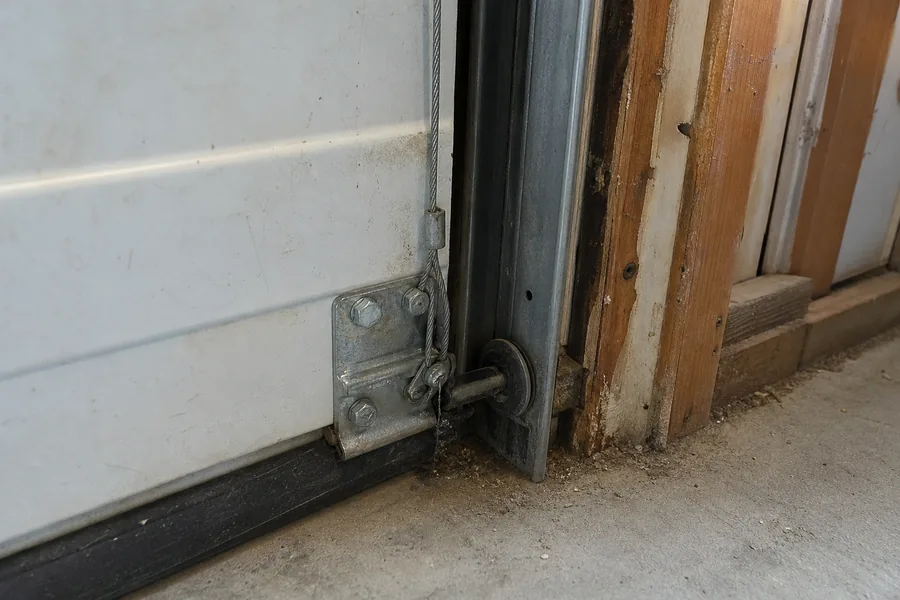
The visit follows a fixed order. First the balance: with the opener disconnected, the technician lifts the door by hand and lets go at several heights to see whether the springs still carry the weight. Then the springs themselves, both cables from drum or pulley to the bottom corner, the rollers, hinges, tracks and brackets, the bottom seal, and finally the opener's settings and safety devices.
Anything worn is shown to you and written up. Nothing is replaced unless you say so.
The wind here never quite stops, and it pushes fine dust under the door and into everything that moves. Grit mixed with old, sticky grease turns into a paste that grinds bearings, slows pulleys and makes rollers skid along the track instead of turning.
So a tune-up here starts with the tracks: the packed grit is cleared out of the channels before anything else. When the technician lubricates the springs, hinges and bearings, it is with a product that does not hold dust, rather than the heavy grease that collects it.
Rollers that have already worn flat or seized are listed separately, with sealed-bearing replacements offered, since those shrug off the dust far longer.
A garage facing west on a July afternoon gets far hotter than the air outside. That heat dries out lubricants, stiffens weatherstripping until it cracks, and bakes the circuit board in the opener mounted up near the ceiling, where the hottest air collects.
A tune-up looks at all three. Seals that have hardened are noted before they split, the opener is run through its full travel to see whether it hesitates or reverses on a warm day, and the board's behavior is checked, since a struggling board often shows itself as a door that stops for no clear reason.
None of that needs fixing on the spot. It needs knowing about before the next heat wave.
An ice storm can glue a door's bottom seal to the slab overnight. When the opener tries to lift a frozen door, either the seal tears or the opener strains against it, and an opener set with too much force can bend the top section where its arm attaches.
A visit ahead of winter checks the bottom seal, sets the opener's force so it stops and reverses instead of pulling against a frozen door, and confirms that the manual release works, so the door can still be opened by hand during a power cut.
A squeal near the top of the travel usually means a dry roller or pulley. A shudder on the way up points to rollers skidding in grit, or a cable that has started to stretch. A door that rises crooked, leaves a gap at one end when it closes, or drifts down after being raised halfway is telling you the springs and cables no longer share the load evenly.
An opener that hums before it moves, starts with a jerk, or reverses halfway down on a hot afternoon belongs on the list too. Any one of these is reason enough to book a visit while the door still works, rather than waiting for the morning it does not.
On the older homes, springs have often been swapped over the decades for whatever was on hand. Mismatched springs lift the two sides of a door unevenly, the cable on the heavier side frays first, and the door starts to rise crooked.
A tune-up on one of those doors includes a look at whether the springs actually match each other and the door's weight. On doors with extension springs along the ceiling, the safety cable that runs through each spring is checked too, because it is what keeps a broken spring from whipping across the garage, and on some old doors it is missing.
Every door gets the same sequence, whatever its age.
Detached garages in the countryside around Tecumseh, Silver Lake and Auburn face open ground on every side, and their doors take more wind and more dust than a door tucked between two houses in town. They are worth seeing more often for that reason.
In the historic streets, many of the garages are detached as well, with older doors that were built heavier than anything sold today. Those doors get the same visit, with extra time on the hinges and the bottom rail, where age shows first.
A balance test with the opener disconnected, a look at the springs, cables, rollers, hinges, tracks and bottom seal, grit cleared from the tracks, lubrication of the moving parts by the technician, opener force and travel settings, and a test of the safety reverse.
It depends on how often the door runs and how much wind and dust it faces. A busy door or one facing open ground benefits from more frequent visits. After the first visit you hear what your door needs.
Because sticky grease holds the dust the wind blows in, and that paste wears bearings and rollers faster. A product that stays dry keeps parts moving without collecting grit.
No visit makes a spring last forever. It catches the signs, such as a gap opening in the coil or a door that no longer holds its place, so the spring is replaced on your schedule.
The bottom seal is checked and the opener's force is set so it stops and reverses rather than tearing a frozen seal or bending the top section.
Only with your agreement. Worn parts are shown to you and listed first, and nothing is swapped unless you say yes.
Yes. The door is inspected, anything worn is written up, and the estimate is free before any work goes beyond the tune-up itself.
Tell us the fault and you'll get a straight answer on whether it can wait. Free estimate anywhere in Shawnee County.
Quicker to talk? Call (785) 498-8618.
Tell us what the door is doing. The estimate is free; the work waits for your yes.