Body shops, warehouses, self-storage lots and the steel buildings on farms and acreages around the county depend on big doors that get opened all day and bumped more than anyone likes to admit. OnPoint Pro Doors Topeka repairs them, from overhead sectional doors to rolling steel curtains and corrugated roll-ups, and the work waits for your yes after a free estimate.
Tell us what the door is doing. The estimate is free; the work waits for your yes.
Springs are rated by how many times they can lift a door, not by how many years they last. A service bay that opens for every car, or a storage lot where each tenant runs their own unit, uses that rating up quickly. So a business door gets springs sized to its real traffic, along with heavier cables and rollers made for steady use.
The warnings show up sooner on a working door than on a house door: one side rising a beat behind the other, a cable starting to unravel by its bracket, spring coils that no longer sit tight together, a bottom section that slams instead of settling. A call at that stage turns a breakdown into a repair booked for a quiet afternoon.
Wind off open ground drives fine grit into everything that turns: roller bearings, the channels a rolling curtain rides in, the bearings at each end of the spring shaft. Parts wear faster than the cycle count alone would explain, and a door that grinds or shudders usually has grit to thank.
A closed metal building in July cooks the circuit board in a door motor, and replacement boards for the common units travel with the technician. Winter brings the opposite problem. An ice storm can freeze the bottom seal to the slab, and running the motor against a frozen door strips its gears or buckles the bottom section, turning a stuck seal into a real repair.
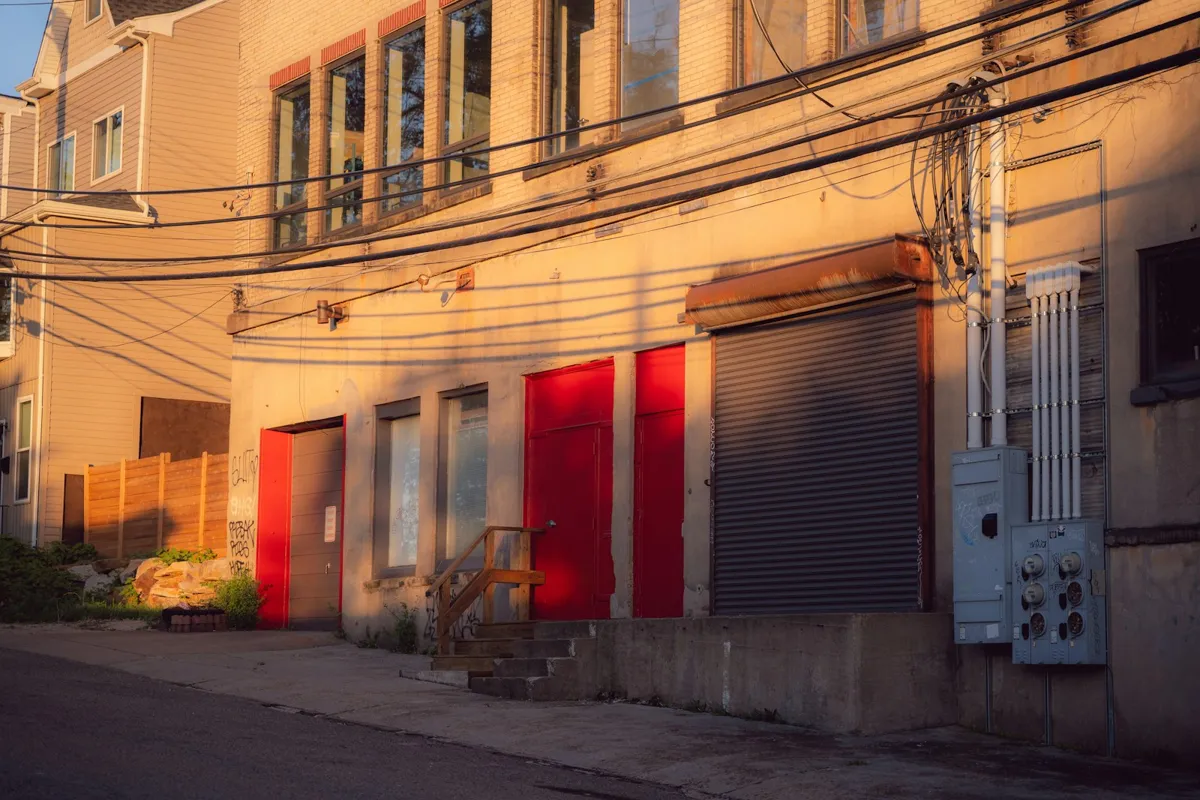
Overhead sectional doors ride on tracks the way a house door does, just larger and heavier, often with insulated sections and windows. A rolling steel door is a curtain of interlocking slats that winds onto a drum over the doorway; its counterbalance springs live inside that drum, and the curtain's edges travel in steel channels.
The ribbed, lightweight roll-ups on storage units and small shops are a separate kind with their own springs and latches. Open-mesh rolling grilles keep a storefront secure while leaving it visible. Out in the county, pole barns, equipment sheds and metal shops carry wide sectional or roll-up doors that see tractors and trailers.
Whatever the type, the work covers the springs, the cables or curtain, the guides, the motor and the safety devices.
Behind most business doors is one of three kinds of motor: one that pulls the door along an overhead rail, one mounted on the wall that drives the spring shaft directly, and a hoist type with a hand chain for when the power fails. The controls are usually a wall station with open, close and stop buttons, sometimes with a timer that closes the door after hours.
Safety comes from a sensing edge along the bottom of the door and a pair of eyes across the doorway, so the door stops and reverses for a person or a vehicle. When either one is damaged or out of line, it is fixed before anything cosmetic, and it is listed first on the estimate.
Every business call follows the same path, so nothing important gets skipped.
A bay that won't close at the end of the day, or a storage gate jammed open with tenants' belongings behind it, moves to the front of the line. The opening is made secure on the first visit, and any special part is ordered for a follow-up.
Once the building can be locked, the remaining work is booked for the quiet part of your week rather than the middle of a rush.
Many barn and shop doors here are still raised by hand or with a chain hoist. Adding a motor is straightforward when the door is in good shape and properly balanced; the springs are looked at first, so the new motor never ends up doing the springs' job.
Every motorized door keeps a way to open it without power, which matters in a county where spring storms bring lines down. When an old motor keeps eating circuit boards or forgetting where to stop, the estimate shows a repair and a replacement next to each other, with the reasoning for each.
Worn bottom rubber lets wind push dust, rain and blown snow under a shop door, and gaps along the sides let heat escape from a bay that runs a heater all winter. Replacing the bottom rubber, the weatherstrip along the jambs and header, and the seals in a rolling door's channels is among the simplest fixes on the list, and the floor stays cleaner the very next windy day.
Where a business heats its work area, an insulated sectional door is worth comparing with the old single-skin one, and it appears on the estimate only as an option, never as a requirement.
Yes. Big sectional and roll-up doors on pole barns, equipment sheds and metal shops are part of the work, along with warehouse and storefront doors.
Overhead sectional doors, rolling steel curtains, corrugated roll-ups on storage units and open-mesh rolling grilles.
Leave the motor off, because running it against a frozen seal strips gears and bends the bottom section, and give us a call. The door is freed and the seal looked at during the visit.
Rarely. Bent sections or crushed slats are usually replaced on their own, and a twisted track or channel is straightened or renewed.
Usually, provided the door is solid and properly balanced. The motor is sized to that door, and you keep a manual way to open it during outages.
It can. Name each door that needs work when you call, and the estimate lists them separately.
Rarely for long. Doors are worked on one at a time, and the bigger jobs are booked for the slowest part of your week so the business keeps moving.
Yes, and it is written per door. Nothing is done until you approve it.
Tell us the fault and you'll get a straight answer on whether it can wait. Free estimate anywhere in Shawnee County.
Quicker to talk? Call (785) 498-8618.
Tell us what the door is doing. The estimate is free; the work waits for your yes.