
A gate operator that clicks without moving, stops short or behaves unpredictably is signaling a fault in its power, board, safety devices, drive or controls. We identify which, at the gate. The estimate is free.
Tell us what the door is doing. The estimate is free; the work waits for your yes.
An automatic gate relies on the operator beside it: a motor and gearbox, a control board that governs its behavior, a transformer or battery supplying power, safety devices that prevent injury, and a receiver awaiting your remote.
Unlike a garage door opener, all of it stands outdoors year-round, exposed to wind-blown grit, summer heat and winter ice, and it asks for correspondingly more attention.
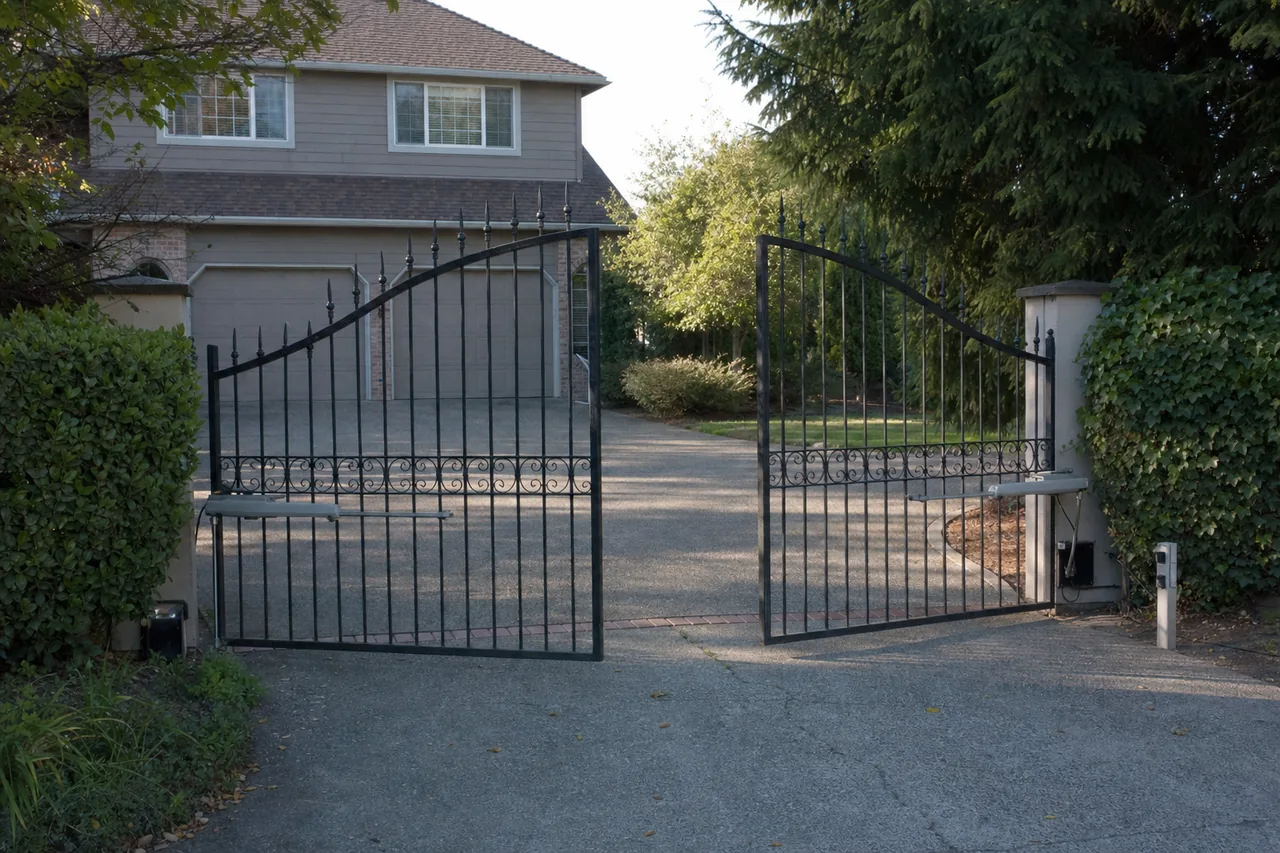
Our work covers swing operators with straight or folding arms, slide operators driven by chain or toothed rack, operators concealed beneath the hinge, and solar as well as mains-powered systems.
Rural properties around Silver Lake, Auburn and Rossville often use solar operators where running power is impractical, while gates near the house are typically hardwired.
In roughly the order we replace them, together with the early warning each tends to give:
A solar operator depends on a battery maintained by its panel. Short winter days, a panel dusted with snow or grit, and cold that reduces battery capacity combine to slow the gate over a series of overcast days until it stops.
The remedy is often a battery replacement. Occasionally a second panel is warranted, or relocating the panel away from shade that has developed since installation.
Hardwired operators fail differently. The vulnerable point is the low-voltage run from the transformer, which may be cut during yard work, damaged by animals or corroded at a splice, so the entire supply is tested before the board is questioned.
Straight arms on most residential swing gates, folding arms where the leaf is hung well behind its post, chain or rack drives on sliding gates, and concealed units under the hinge where appearance matters most.
Paired gates introduce an additional consideration: the two operators must remain synchronized. When one lags, the leaves may collide or bind at the center, and restoring their timing is part of the repair.
Most won't-close calls come down to a safety device giving a false reading: a lens dulled by grit, an eye clipped by a mower, a damaged contact edge, or a loop still sensing a vehicle that has driven off.
The operator is designed to remain open whenever there is doubt. That is correct behavior, so the remedy is to repair the device, never to disable it.
Five questions, always asked in the same order, because each answer rules out a whole family of faults and keeps the visit short.
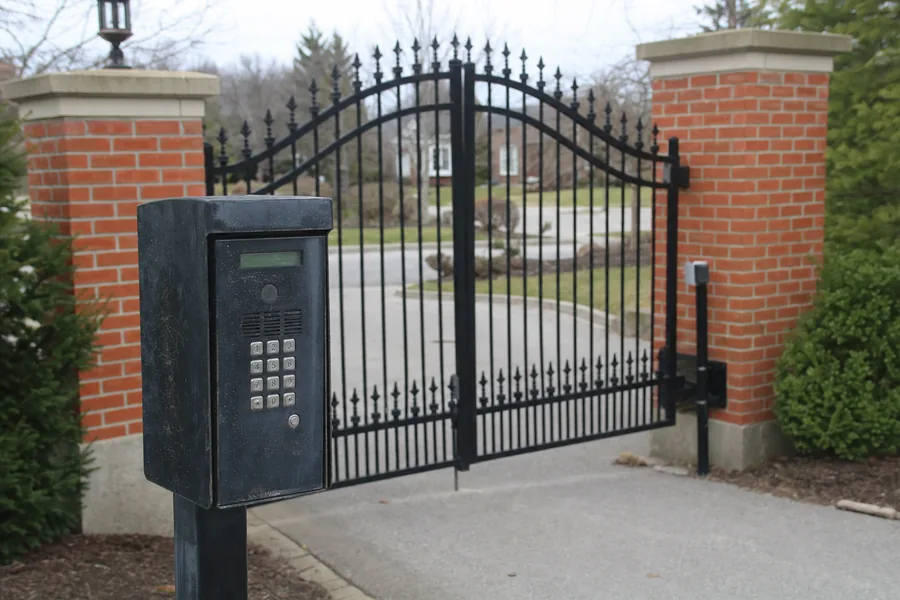
A gate is only as useful as the things that command it: the keypad on its post, the remote in the car, the intercom by the entrance and the loop in the pavement. Each ages independently of the motor, and each is tested on its own.
Every control intended to open the gate is tested before departure, and receivers whose range has diminished are replaced.
Most visits end in a repair: a board, a battery, a capacitor, travel settings, a safety device or a receiver. A new operator becomes the sensible choice only when the motor has failed, parts are no longer made, or the gate now outweighs the operator's design.
In either case, the gate must first move freely by hand. A new operator on a dragging gate will not last a season.
Before anything is ordered you hear the reasoning, set out with the free estimate, and the choice stays with you.
Summer heat bakes boards and batteries inside their housings, wind drives grit into every opening and onto every lens, and ice storms freeze latches and coat the safety eyes.
The calls follow the calendar: boards and batteries through the hottest weeks, eyes after the windstorms, batteries and loops in deep cold. A fall service visit anticipates most of it.
That visit includes a battery load test, confirmation of travel settings, lubrication of hinges and rollers, inspection of housing seals, and a test of every safety device with the gate in motion.
Around here the familiar names are GTO, Elite, FAAC, DoorKing, Viking, US Automatic, Nice and Apollo, Mighty Mule and LiftMaster. For a rarer make, a photograph of the label lets the correct part be ordered before the visit.
Whether a light is showing on the operator, whether it clicks, hums or remains silent, whether a storm or outage preceded the fault, and whether every control has stopped or only one. Those answers determine which parts are brought.
Please leave the covers closed and the safety devices connected, and avoid running the motor repeatedly against a gate that will not move.
If the gate is stuck open and must be closed for the night, please say so. Securing it by hand is the first step, even when a part must be ordered.
If a vehicle is shut in behind a gate that will not open, say that as well; getting it out comes before anything else.
Rarely. A safety device reporting an obstruction that isn't there is much the likelier culprit, and the devices are checked one after another until it shows itself.
Yes. The battery, the solar regulator, the panel wiring and the operator are each examined, and most solar visits conclude with a fresh battery or a panel relocated out of shade.
The common makes and most uncommon ones. The principles apply across brands, and parts are ordered by model. Older and discontinued models can often still be supported with compatible boards.
No. The device holding the gate open is doing what it was designed to do, and the fix is to repair it. A gate should never close without them.
On most days. A gate stuck open is a security concern, and time is reserved for it, as it is for a vehicle shut in behind a gate that will not open. Say so when you call.
Yes. You are told what has failed and what is required before any work begins, and nothing is ordered without your approval.
Both. The operator accounts for most of the work, and when hinges, rollers or posts are to blame, they are dealt with on the same visit. One visit usually covers both.
Call and describe what the operator is doing. We will agree on a time that suits you, with a courtesy call once the technician is on the way.
Free estimate.
Leave a name, a number and a sentence about the gate operator; that is sufficient. Both the visit and the estimate are free.
Quicker to talk? Call (785) 498-8618.
Tell us what the door is doing. The estimate is free; the work waits for your yes.