
Automatic gates rarely fail without warning: more noise than last month, less speed, a latch that needs a second try. What those signs mean, and how the repair is carried out. The estimate is free.
Tell us what the door is doing. The estimate is free; the work waits for your yes.
Automatic swing and sliding gates in steel and aluminum: paired leaves at a residential drive, a sliding gate across a commercial yard, a single leaf at the entrance to a shared lane, cantilever gates that ride without a ground track.
Around the county that includes long drives where the gate stands well away from the house, and business yards where the gate cycles dozens of times in a working day and wears accordingly.
The gate's hardware and the operator that moves it are treated as a single system, since a problem in one invariably affects the other.
Gates serving several households or a business are given priority, since a failure there affects many people at once.
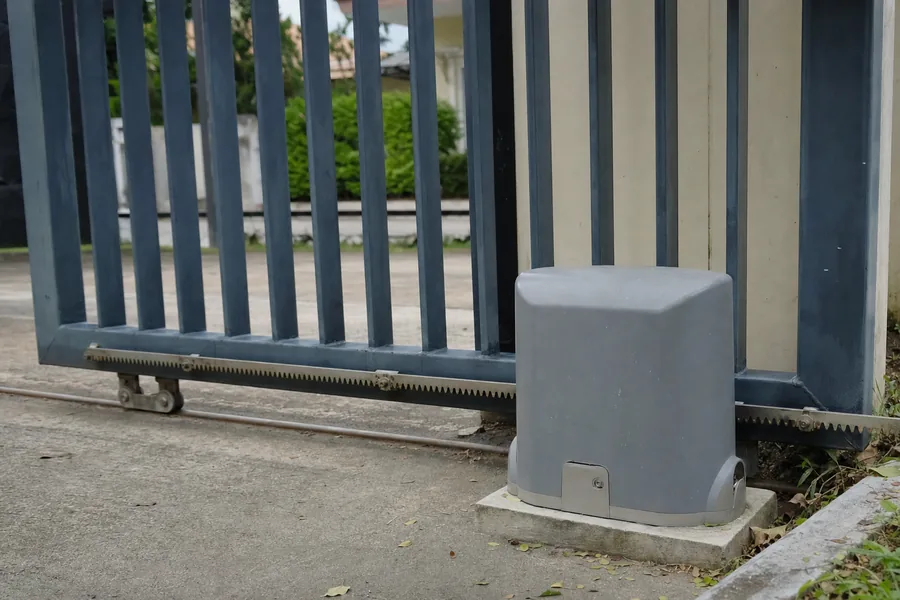
Most gate faults trace to one of the components below, and the symptom generally indicates which.
An operator is designed for a gate that moves freely by hand. Once a hinge wears or a post leans, each cycle becomes a struggle, the motor runs hot, the gears wear, and eventually the operator stops.
The warning signs arrive well before the failure: a leaf that needs a second push to latch, a new squeal at one hinge, a motor that sounds labored on the last few feet. Reporting them early turns an emergency into a scheduled repair.
Sliding gates fail similarly from the ground up. A track clogged with gravel, ice or debris forces the rollers to climb, and the operator strains on every trip. The gate is therefore corrected before the operator is assessed.
Most repairs are completed on the first visit, because the components that fail most often are carried on the truck.
Kansas weather tests a gate from every direction. Wind drives grit into hinges and onto lenses and strains swing leaves against their stops; summer heat bakes the electronics inside sealed housings; ice storms coat every surface and freeze latches in place.
The ground moves as well. Freeze and thaw shift posts and open cracks across loop cuts, and a gate that was level in October may drag by March.
Wind deserves particular mention. A solid swing leaf behaves like a sail in a strong gust, and repeated strain works hinge fastenings free and bends arms. Gates facing open ground often benefit from a heavier arm or a positive stop.
An operator that runs, for which parts remain available, on a gate that moves freely, is almost always worth repairing. Operators fail one component at a time, and each component can be replaced. Most of our gate visits end with the original operator still in service.
When replacement is warranted, the new unit is selected for the gate's actual weight and length and for the gusts that strike it, and the gate is corrected beforehand.
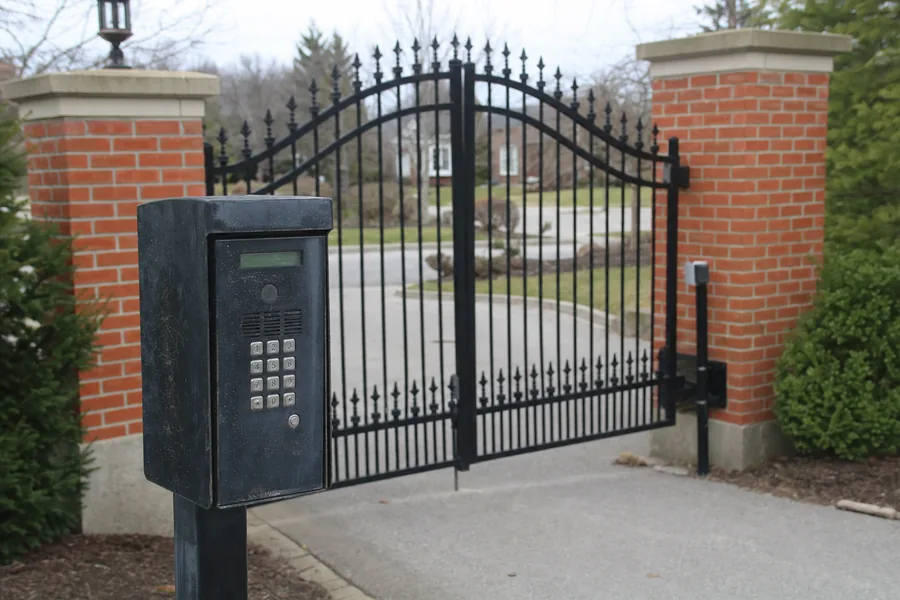
A gate that responds to the remote but not the keypad, or the reverse, has a control fault rather than a motor fault. Receivers lose range, keypads wear, and loops break as the pavement moves, and each of those is tested separately before anything is replaced.
Programming, receivers, keypads, intercoms and loops are all addressed, usually during the same visit.
Gates shared by several households tend to accumulate old codes and unaccounted-for remotes. Clearing the receiver and issuing fresh codes to current residents restores control over who can enter.
Whether a light is showing on the operator, whether it makes any sound, whether a storm or outage preceded the fault, and whether every control has stopped or only one. Please leave the covers in place; those answers are what the technician needs. A photograph of the operator's label is also helpful.
Please do not force a gate that is still connected to its operator. Doing so bends the arm and strips the gears, turning a modest repair into a substantial one.
Most residential gates in the area use LiftMaster, Mighty Mule, Nice or Apollo, Viking, DoorKing, Linear, Elite, FAAC or GTO operators. Common parts are carried; less common ones are ordered once the model is confirmed. A photograph of the operator's label, sent ahead, often saves a second trip.
A gate that moves freely by hand yet will not run points to the operator itself: power, board, capacitor, travel settings or drive. The gate opener page describes that visit in detail, including the order in which faults are traced.
Most often a safety device: an obstructed or misaligned eye, or a contact edge that has failed. Those are checked before anything else is touched.
Usually. The components that fail most often for common makes are carried, and if a part must be ordered, you are told at the gate how long it will take.
Yes. A property open to the street receives the same priority as a garage door that will not close, and the gate is secured by hand if a part must be ordered, so the property is not left open overnight. Say so when you call, and it moves up the day.
Generally, yes. The exceptions are a burned-out motor, a discontinued model, or a gate that now exceeds the operator's rating. You are told which applies before anything is ordered.
Yes, provided the gate moves freely by hand and the posts are sound. Both are assessed first, and you are told which operator suits the gate and why. Solar and hardwired options are both explained.
Yes, together with receivers, intercoms, phone entry and loops, typically during the same visit. Codes for shared gates can be reissued at the same time.
Annually, ideally in the fall: hinges and rollers lubricated, track cleared, battery tested, and travel settings and safety devices confirmed before winter. Gates on busy business entrances benefit from a visit every six months.
Call and describe what the gate is doing. We will agree on a time that suits you, with a courtesy call once the technician is on the way. Business gates can be scheduled around opening hours.
Free estimate.
Leave a name, a number and a sentence about the gate; that is sufficient. Both the visit and the estimate are free.
Quicker to talk? Call (785) 498-8618.
Tell us what the door is doing. The estimate is free; the work waits for your yes.